

Meet ACO360.
PCP 1st brings the care team. Caesar connects the follow-up. Together, we're planning care beyond the high-cost list.
PCP 1st × Caesar Health · Updated November 6, 2026
How the planned program would run
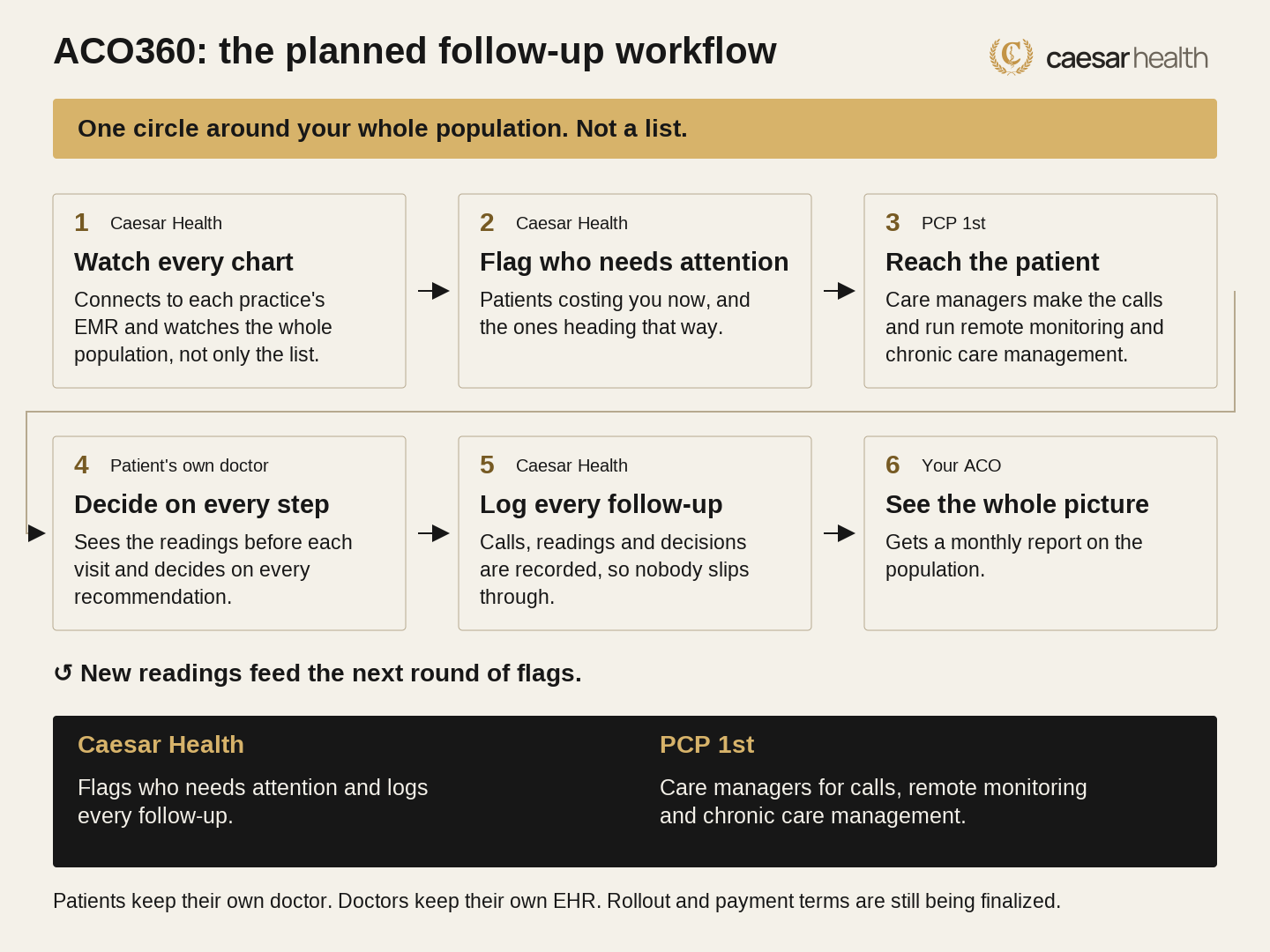
Follow risk and care across participating practices.
- Caesar Health
Watch every chart
Reviews charts across participating practices to identify patients who need attention.
- Caesar Health
Flag who needs attention
Flags high-cost patients and those whose risk is rising.
- PCP 1st
Reach the patient
Care managers make the calls and run remote monitoring and chronic care management.
- Patient's own doctor
Decide on every step
Sees the readings before each visit and decides on every recommendation.
- Caesar Health
Log every follow-up
Records calls, readings and decisions. Open follow-ups stay visible.
- Your ACO
See the whole picture
Gets a monthly report on the population.
New readings feed the next round of flags.
Caesar Health
Flags who needs attention and logs every follow-up.
PCP 1st
Care managers for calls, remote monitoring and chronic care management.
Why watch the whole population
Your high-cost list shows today's expensive patients. It changes every year. Others in your population may be getting worse and heading toward it.
ACO360 is planned for intervention with high-cost patients and prevention for those heading that way.
Caesar would review charts across the population. PCP 1st's care managers would handle follow-up.
Illustrative case
A reading that needs follow-up
A patient in the proposed diabetes and kidney disease cohort has a flagged reading between visits.
Reading flagged
Caesar flags a reading that needs attention.
Patient outreach
A PCP 1st care manager calls the patient.
Doctor review
The patient’s doctor reviews the reading and decides what happens next.
Follow-up recorded
Caesar records the decision and keeps open work visible.
The ACO360 ecosystem
The planned model connects population health, technology and clinical care with care management, performance and operations.
Why start with diabetes and kidney disease
Spending concentration
Share of U.S. healthcare spending, 2022
Kidney disease and awareness
Medicare spending
Nearly $77B2021 spending for beneficiaries 66+ with CKD, excluding kidney failure
CMS ACCESS model
Cardio-kidney-metabolic track
- Diabetes
- CKD stages 3a and 3b
- Atherosclerotic cardiovascular disease
Final ACO360 cohort criteria require clinical approval. CMS ACCESS is a separate payment model.
2 in 3 new kidney failure cases are caused by diabetes or high blood pressure. CDC
Who does what
The ACO
Set the cohort
- Agree on entry criteria
- Review and approve final thresholds
Caesar Health
Find patients
- Screen participating EMRs
- Send matches to the ACO for approval
PCP 1st
Enroll and equip
- Enroll patients
- Coordinate BP cuffs and glucose monitors
- Confirm fulfillment and costs
Caesar Health
Monitor readings
- Review daily cuff, CGM and wearable readings
- Prioritize out-of-range readings
- Confirm device connections
PCP 1st
Follow up
- Contact patients and support medication adherence
- Manage monthly chronic care
- Send recommendations to the patient’s doctor
Caesar Health
Report monthly
- Enrollment and reading adherence
- Escalations and open care gaps
Example criteria for clinical reviewType 2 diabetesA1c > 8%eGFR < 60
Patients keep their primary care provider. PCP 1st would co-manage care. Confirm attribution before enrollment.
How a patient moves through the program
- Cohort. The ACO sets criteria and approves the patient list Caesar returns.
- Enrollment. PCP 1st would contact patients, record consent and arrange devices.
- Daily readings. Proposed cuff and CGM readings follow clinician-set thresholds. Confirm device support. See RPM alerting.
- Follow-through. Retake an out-of-range reading. A confirmed alert becomes a same-day care-team task. Severe symptoms go to 911.
- The visit. The provider would receive BP and CGM reports before the visit and mark them reviewed.
- Month end. The ACO would receive its cohort report.
Built so the ACO keeps control
- The ACO picks the patients. Apply agreed criteria to the roster. Enrollment requires ACO approval.
- The PCP relationship stays. PCP 1st would co-manage. The patient's provider reviews readings before visits.
- Device costs. Agree who supplies and pays for each device before enrollment. Medicare CGM coverage depends on CMS criteria, including insulin treatment or qualifying hypoglycemia. CMS LCD L33822. Many proposed patients may not qualify. PCP 1st supply terms need confirmation.
- Subscription and clinical costs. The proposed model uses a cohort-sized platform subscription. Final payment terms and billed clinical services still need agreement.
What your ACO and its practices keep
Patients keep their doctor and practices keep their EHR. Confirm attribution in the care and billing agreement.
PCP 1st care managers would call patients and run remote monitoring and chronic care management. The patient's doctor decides on each care-plan recommendation. Record accepted, adjusted and declined recommendations, with reasons.
What exists today
Live in Caesar today
- Enrollment outreach with timestamped consent
- Every outreach attempt logged
- Reading alert rules with named staff tasks
- Monthly review drafts and human billing gates
Planned with PCP 1st
- ACO360 with PCP 1st's care team
- The six-month pilot scope
- Rollout and payment terms
In build or on the roadmap
- Direct device connections. Device-platform exports work today.
- Device logistics: assign, ship and return
- Per-program leadership reporting
- Automated insurance eligibility checks
Costs: read the invoice and the claims
A zero-fee program can still add Medicare claims. Traditional Part B monitoring and care management count toward ACO spending.
Ask each vendor, including us, for the invoice and expected claims. ACO360 rollout and payment terms are being finalized.
Before enrollment, document technology, device and clinical costs. Include the baseline and review date.
Measure what happened after the flag
Track referrals and bookings separately from completed care. Record patient declines and clinician-directed closure as distinct outcomes. Keep unresolved work visible.
Set a baseline and decision date. A proposed six-month pilot includes enrollment and device setup. That leaves roughly three months of readings to assess.
Six things to settle before a pilot
Which practice goes first?
Pick one sitting just below your par, not your worst office. Plan on 100 to 300 patients.
Ask: Why this practice?
Who calls, and what happens after the last attempt?
Patients nobody reached should stay visible, with an owner.
Ask: Where do unreached patients go?
What does the PCP receive?
Sent, delivered, filed and reviewed are four different timestamps.
Ask: Which one can you show?
What does it cost, all in?
Fees to the ACO, plus billed services that count in your spending.
Ask: Can you see both numbers?
Whose minutes count?
Agent activity isn't clinical staff time. A text isn't a live call.
Ask: Are they in separate columns?
When do you decide?
A decision date and a decision owner, written before enrollment.
Ask: Who decides, and on what day?
Already have a clinical team?
Your team can keep clinical delivery for chronic care and remote monitoring. Caesar organizes outreach and review drafts. Human staff approve billing readiness and submit claims.
Compare the two paths for ACOsMeet us in Orlando
Shoukri Kattan, Caesar Health's CEO, will be at FLAACOs on November 9. Dr. Yeeny Gonzalez, PCP 1st's CEO, is on The High-Cost Patient Playbook panel. Michael Zaplin and Munir Khatri are also on it, and Mark Aspenson moderates. The panel runs Monday, November 9, 12:30–1:20 PM Eastern. It's at the JW Marriott Orlando Bonnet Creek.


About PCP 1st
PCP 1st, based in Boca Raton, Florida, works with CINs, ACOs, MSOs and individual provider offices. Its care managers run chronic care management and remote patient monitoring. pcp1st.com
About Caesar Health
Caesar Health is a clinic operating system. Its AI agents handle the phone, the fax inbox and device data. They also run follow-up tasks inside the EMR a practice already uses.
Read the white paper PCP 1st and Caesar Health submitted to CMS QualTech 2026. See how Caesar connects to existing EMRs.
ACO360 is planned. Rollout and payment terms are still being finalized.
Frequently asked questions
What is a high-risk, high-cost patient program?
An ACO defines a patient group for care between visits. The proposed ACO360 model combines connected devices, monthly care management and same-day follow-up. Patients keep their primary care provider. Diabetes with CKD is a potential starting cohort.
Which patients qualify?
The ACO and clinicians agree criteria. Example for clinical review: type 2 diabetes, A1c above 8% and eGFR below 60. Hypertension and heart-disease criteria could be added. Final criteria require clinical approval.
Does the patient change primary care provider?
No. PCP 1st would co-manage with the existing primary care provider. The provider would receive BP and CGM reports before visits.
Will every attributed patient be enrolled in chronic care management?
No. Enrollment would follow the ACO's criteria and approved patient list.
Does PCP 1st's Medicare billing count toward the ACO's spending?
Traditional Medicare monitoring and care-management claims count toward ACO spending. Confirm the billing arrangement before enrollment. Target the agreed cohort and measure any avoided admissions. CMS Shared Savings Program.
Who pays for the continuous glucose monitor?
Device supply and payment need agreement. The proposed model has PCP 1st supplying CGMs. Medicare coverage depends on CMS criteria, including insulin treatment or qualifying hypoglycemia. Some proposed patients would not qualify. CMS LCD L33822.
Which EMRs does it work with?
The proposed workflow uses APIs where available and a browser agent otherwise. Practices keep their EMR. Confirm each connection before rollout. See EMR integrations.
What does the ACO pay?
Payment terms are being finalized. The proposed model uses a flat platform subscription sized to the cohort. Agree technology, device and clinical costs before enrollment.
How is this different from a remote patient monitoring vendor?
The proposed program combines devices and readings with clinical follow-up and a monthly ACO report. The ACO approves the patient group.
How does an ACO start?
Book a call. Review EMR or claims data and agree patient criteria. Then scope the proposed six-month pilot, costs and review date.
Bring the practice you'd start with.
Compare your practice's current program with the planned ACO360 workflow and follow-up responsibilities.
Choose a time directly in the calendar.